
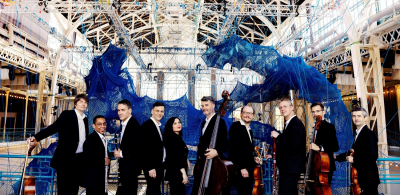
The second concert of the Melos-Étos 2026 festival, entitled Sonic Bridges, will take place on Wednesday, 4 November, at 7:00 PM in Moyzes Hall, performed by Quasars Ensemble. The concert offers an encounter with the diverse forms of contemporary chamber music. Six works by six distinctive composers will create a space in which sound becomes a vehicle for images, emotions, memories and unexpected meanings.
The programme features works by Dai Fujikura, Jozef Podprocký, Tomáš Kobielsky, Victor Báez, Viera Janárčeková and Hanurij Lee. Although each composer approaches musical material in a distinctive way, their work shares a sensitivity to timbre, detail and the relationships between individual musical events. Rather than presenting clear-cut narratives, they invite listeners into an open space for personal interpretation and discovery.
From Invisible Fragrance to Points of Sound
The programme opens with Portal Essence (2023) by Japanese composer Dai Fujikura, inspired by the world of perfumery and the cultural meanings associated with fragrance. The composer draws parallels between composing music and blending perfume: both processes work with layers, intensity, traces and memories. Here, fragrance is transformed into sound – something invisible yet intensely present, gradually unfolding, changing and eventually dissolving. The work received its world premiere in Vienna in August 2026, performed by Quasars Ensemble.
A different perspective on musical structure emerges in Pointilissmi (2026), a new work by young Slovak composer Tomáš Kobielsky, which will receive its premiere at the concert. Inspired by the painting technique of pointillism, the composer translates its principles into the realm of sound. Small, fragmented sonic objects are assembled into ever-changing wholes, shaped by their timbre, register and gestural character. As with a painting composed of countless individual dots, the overall impression emerges from the interplay of its smallest details.
Between Breath, Sorrow and Silence
A powerful emotional dimension is introduced by La luz bermeja (2024) by composer Victor Báez. The work draws inspiration from Pedro Páramo, the novel by Mexican writer Juan Rulfo, in which the memory of a lost love is intertwined with the image of a strange, deep-red light. Báez captures the moment when an ordinary breath turns into a sigh and sound becomes an expression of grief. Written for flute, clarinet, cello and piano, the piece explores the fragile boundary between physical gesture and inner experience.
A world of delicate sonic nuances unfolds in Ein Hauch von Zen (2006) by Slovak composer Viera Janárčeková. Her musical language moves along the boundary between silence and sound, inhabiting a space of subtle gestures, microtonal nuances and constantly shifting sonic relationships. Here, fragility does not signify weakness; rather, it reveals the ability to uncover an entirely new musical world through almost imperceptible changes.
Gregorian Chant as a Starting Point, Music as Dialogue
A special place in the programme belongs to Fantázia IV. na sekvenciu „Laeta dies“, op. 73 (2019) by Jozef Podprocký, a distinguished Slovak composer who lived from 1944 to 2021. Written for piano four hands, the work is the last of his four fantasias and his final composition. Gregorian chant serves as the foundation for an intricate musical architecture built on counterpoint, intervallic mirrorings and striking harmonic contrasts. The two pianists create a complex dialogue between musical lines, in which the ascetic simplicity of chant fragments meets virtuosic sonic richness.
The programme concludes with Stuff #2A (2024/2025) by South Korean composer Hanurij Lee. She is interested in repetition as a process that transforms not only the sonic material itself but also the way we listen to it. What initially appears unchanging gradually reveals subtle differences, new textures and unexpected connections. The individual musical layers need not converge towards a shared conclusion; they can simply coexist, establishing relationships through their proximity, distance and constant transformation.
The evening’s performers will be Quasars Ensemble, a Slovak ensemble founded in 2008 and one of the country’s leading groups specialising in contemporary classical music. Under the artistic leadership of conductor, composer and pianist Ivan Buffa, the ensemble develops programmes that connect contemporary musical creation with the legacy of earlier periods, while regularly collaborating with prominent Slovak and international composers and performers.
The ensemble has appeared at renowned festivals and concert venues across Europe, Asia and South America, released 17 albums and received numerous national and international awards. Its performances are distinguished by meticulous attention to detail, sonic precision and an openness to new compositional approaches.
The performers at Sonic Bridges will be Ivan Buffa (conductor, piano), Audrey G. Perreault (flute), Jozef Eliáš (clarinet), Diana Buffa (piano), Peter Mosorjak (violin) and Arne Kircher (cello).
Tickets are available through Ticketportal:
https://www.ticketportal.sk/event/Melos-Etos-2026
Tickets will also be available at the concert venue one hour before the performance.
SONIC BRIDGES
- Venue: Moyzes Hall, Bratislava
- Date & Time: Wednesday, November 4, 2026, 7 pm
- Performers: Quasars Ensemble (Slovakia)
For more information, visit www.melosetos.sk(opens in a new window).