
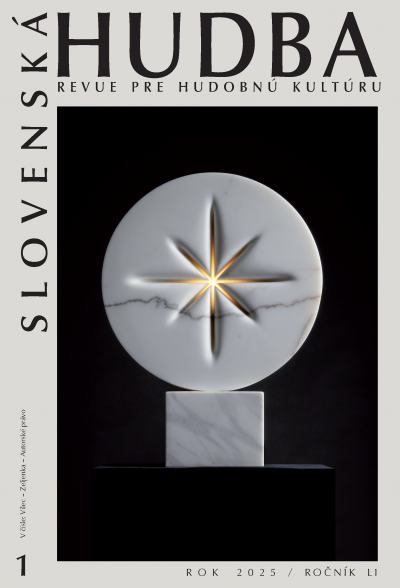
Slovenská hudba 1/2025
back to list
-
Autor:
rôzni
-
Category:
-
ISBN:
13 35-41 40
-
Published:
2025
-
Number of pages:
99
-
Price incl. VAT:
€5,00
-
Price without VAT:
€4.76
-
Stock status:
In stock
- Buy a digital version
Disclaimer: This publication is originally written in Slovak. The following is an English translation of the editorial (preface) section from the journal Slovenská hudba, Issue 1/2025.
“I am not what happened to me, I am what I choose to become.”
Carl Gustav Jung (1875 – 1961)
Dear readers,
The words of Swiss physician, psychiatrist, and psychotherapist Carl Gustav Jung open my remembrance of a remarkable person – musicologist and a significant figure in Slovak music museology, PhDr. Edita Bugalová, who left our musicological circles forever on March 24, 2025.
PhDr. Edita Bugalová (1951 – 2025) always had a close relationship with musical art – both of her parents and older sisters played musical instruments, and already in childhood she attended a church music ensemble led by Mikuláš Schneider-Trnavský at the Trnava Cathedral. There she began learning to read music even before she started attending the Music School in Trnava. “More than practicing piano études and scales, I was drawn to pop music,” Edita Bugalová confessed in an interview. “Our generation was captivated by beat music. I learned to play the guitar, played in all-girl bands (even on drums), and sang with a dance orchestra.”
She eventually decided to study musicology at Masaryk University in Brno, which led her to the Western Slovak Museum in Trnava, where she accepted a position as a music historian, managing the legacy of M. Schneider-Trnavský. Coincidentally, her relationship with this figure deepened when she married his grandson. She held this position for sixteen years and decided to dedicate her life to regional music historiography: “We should systematically learn and uncover the legacy of our ancestors and the figures who shaped our cultural history. Without knowledge of our roots, we remain lost,” she said.
“We are unable to orient ourselves, name causes and consequences of actions... this ‘rootlessness’ manifests in fragmented opinions, without the ability or even ambition to articulate arguments.” She remained true to this credo even after becoming director of the Slovak National Museum – Music Museum in Bratislava, where she worked for more than twenty years. She engaged in professional curatorial, journalistic, editorial, and publishing activities. Among other things, she initiated the restoration of the manor house in Dolná Krupá, which became part of the Music Museum in 2003.
In the field of music museum work, she led nationwide and international presentation projects (exhibitions, reviving music), organized conferences and seminars, and also participated in historical music research. She was a member of the Slovak Musicological Association, the Musicological Committee of the Music Fund, and from 2014 to 2022 also a member of the Board of the Music Fund. She never forgot Trnava and, since 2008, served as a member of the Cultural Council of the Trnava Self-Governing Region.
“I am not what happened to me, I am what I choose to become,” said C. G. Jung. Edita Bugalová chose to become a music scholar and museum professional focused on regional Slovak history, passing her enthusiasm for this work on – to her children, grandchildren, students, and younger colleagues, ensuring her legacy remains alive.
Dear readers, this remembrance of a kind and extraordinary colleague is followed by a brief overview of the first issue of the 51st volume of the musicological journal Slovenská hudba. This thematically rich issue explores various areas of musicology and offers not only studies but also a reflection, an essay, and reviews.
We begin with a short tribute to the last bard of Slovak musical avant-garde of the 1960s – Miro Bázlik – written by Vladimír Godár (Miro Bázlik – Epoché). This is followed by an analytical contribution by Renáta Kočišová focusing on Michal Vilec’s work for cello (Sonata 1, Op. 1, for Cello and Piano – a Resurrection of the Sonata Cycle in 20th-Century Slovak Music).
Laura Karas Belicová reflects on Antonín Dvořák’s famous opera Rusalka. This is the first part of a larger study (the second part will appear in the next issue) examining the relationship between reality and mysticism, the libretto and the atmosphere of the time, text and musical expression (The Real and the Virtual in Antonín Dvořák’s Opera Rusalka).
Artificial intelligence is increasingly entering our lives. Are we ready for it? Is copyright law ready? These and other issues are addressed by Rebeka Camastrová (Current Copyright Issues).
We are always pleased when performers reflect on music based on their own creative experience. In this issue, performer Magdaléna Bajuszová shares her reflections on interpreting the music of Ilja Zeljenka (In Ilja Zeljenka’s Joyous Solitude / Searching for Freedom in Oppression / Reminiscences and Reflections of the Performer).
Opera director Pavol Smolík also raises questions in his article, attempting to identify challenges in composing opera for children (Opera for Children. Definition, Problems, Questions).
In conclusion, we present two reviews: Yvetta Kajanová reviews Július Fujak’s new work Other Music Discourses, Compositions, Interviews, Essays/Reflections, and Janka Bednáriková reviews Mária Strenáčiková’s Slovak-English Dictionary for Musicians, Musicologists, Music Teachers, Pupils and Students of Musical Arts and its English-Slovak counterpart.
Dear readers, I hope the contributions in the first issue of Slovenská hudba 2025 will capture your interest and inspire you to reflect on the questions raised.
Alena Čierna