
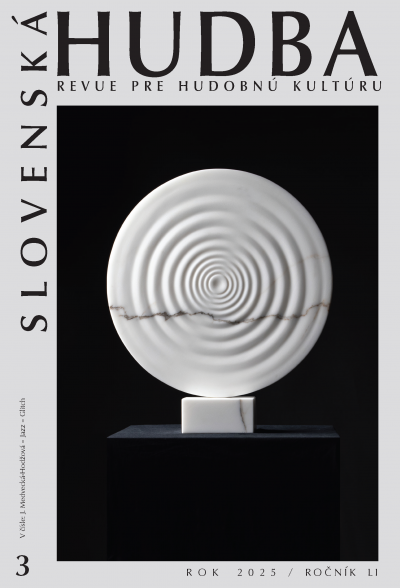
Slovenská hudba 3/2025
back to list
-
Autor:
rôzni
-
Category:
-
ISBN:
13 35-41 40
-
Published:
2025
-
Number of pages:
324
-
Price incl. VAT:
€5,00
-
Price without VAT:
€4.76
-
Digital version price with VAT:
€5,00
-
Digital version price without VAT:
€4.76
-
Stock status:
temporarily sold out
- Buy a digital version
Standard version
Standard printed version of the publication.
Digital version
Electronic version of the publication in
PDF format licensed to the buyer's name.
PDF files can be printed.
“The medium is the message.” Herbert Marshall McLuhan (1911–1980)
Dear readers, every new issue of the musicological journal *Slovenská hudba* inspires me to reflect on new impulses, ideas, or considerations processed by the authors of individual contributions. I must admit that with the third issue of the 51st volume of *Slovenská hudba* I hesitated for a long time – in which direction should my introductory thoughts go? Should I delve into the history of Slovak musical culture, or let myself be carried away by visions of the future development of music? The new issue of *Slovenská hudba* brings both of these perspectives. In the end, I decided to devote a few thoughts to the role of new media in shaping musical consciousness, taste, and creation. Marshall McLuhan, the Canadian media theorist, literary critic, rhetorician, and professor of English literature who laid the foundations of media theory, argued that “... media are so pervasive in their political, economic, aesthetic, psychological, moral, ethical and social consequences that they leave no part of us untouched, unaffected, unchanged... Any understanding of social and cultural change is impossible without a knowledge of the way media work...” (*The Medium is the Message*, 1967). At the time when McLuhan formulated these ideas, rock music was experiencing its peak. McLuhan wanted to draw attention to the fact that radio waves, television screens, and other electronic devices alter the perception of reality. More than ever before, media began to participate in the “creation” of music, musical styles, and genres. It cannot be denied that in the 20th century the rapid pace of development of new musical styles, directions, and genres (not only in popular music) was driven by technological progress. Looking into music history, we see that in the past, music was renewed by a new style or genre roughly every few decades. In the 20th century, the renewal process accelerated significantly. In the field of popular music, we can mention blues, jazz, rock, hip-hop, and many other new styles that brought fresh air and new energy to music. At the beginning of the digital age, however, it seemed as if this development had slowed down. The reason was the enormous growth of new styles, genres, and subgenres, yet none of them became a distinct mainstream genre in the way rock once had. As Ted Gioia writes: “When the streaming platform Spotify decided to define all musical styles, it ended up with 1,387 categories.” It is enough to type EDM into Google and (without claiming completeness) you will find that its categories include Breakbeat, Breakbeat Hardcore, Breakcore, Chiptuning, Dance Rock, Digital Hardcore, Disco, Drum and Bass, EMB, Electro, Eurobeat, House, Glitch, Techno, and many others. Often just a slight change in sonority, beat, or similar elements brings a new category and a new name applicable only to a narrow circle of authors. At no time in human history has music been as affected by technological and economic transformations as it is today. These changes conceal great danger for all who wish to make a living through music. Although the internet has enabled artists to edit and distribute music, the cost of production has dropped dramatically. Revenues from recordings have plummeted and audio media have become an economic burden for publishers. Streaming and Facebook “likes” have become the primary — though diminished — form of social interaction between youth and music; youth who allow themselves to be intoxicated by “pure” melodies (often modified through Auto-Tune) over a repetitive rhythmic loop. Dissonances and the tritone, which gave functional harmony tension and life, have disappeared from melodies. Contemporary creators of popular music in the digital age often reach for perfect and regular patterns that enable them to produce polished music. The second digital revolution in music lies in the fact that software and algorithms are used in almost every decisive step. Artificial intelligence now composes, performs, organizes, analyzes the commercial potential of music, and finally sells the product to the consumer. Will artificial intelligence manage to tame music into perfect and regular patterns? Let us reflect for a moment and we realize that however pessimistic this vision of AI-dominated music may be, it is unlikely as long as the human brain continues to function as it has. Research shows that we are excited by musical elements that we do *not* expect — not by those that repeat regularly and predictably. Emotions, personality, and deliberate subversion play a significant role in music, surviving even in the most controlled environment, and once given the chance, they always manifest themselves. Music is, after all, a force of change, transformation, and enchantment in human life. Dear readers, we are pleased that in the third issue of the 51st volume we can, through the study of Juraj Ruttkay, on one hand delve into the regional history of Slovak music and introduce the personality and ideas of the pianist Jela Mevecká-Hodžová (Jela Medvecká-Hodžová in Slovak critiques and in her Geneva correspondence with Anna Kafendová-Zochová). At the same time, we present studies by young authors who devoted themselves to various topics in the field of popular music and brought rarely discussed themes to our pages: – **Matej Buček – A comparative analysis of selected Slovak jazz albums** – **Matúš Piasecký – Glitch Music** – **Renáta Iršová – Humor, irony, parody and extramusical elements in the work of Dan Heriban** I hope, dear readers, that today’s topics will interest you and that you will immerse yourselves in them with the same enthusiasm with which we have prepared them for you. I wish you inspiring moments with *Slovenská hudba*.
Alena Čierna