
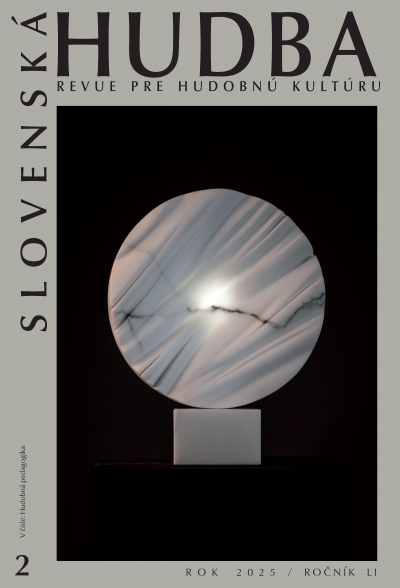
Slovenská hudba 2/2025
back to list
-
Autor:
rôzni
-
Category:
-
ISBN:
1335-2458
-
Published:
2025
-
Number of pages:
207
Slovak Music - Introduction
Introduction
"Tell me and I will forget, show me and I will remember, involve me and I will understand."
Chinese proverb
Dear readers, as the opening quote suggests, the main focus of this second issue of the 51st year of Slovak Music is questions of music education. When I was reflecting on which direction to take this editorial, several themes immediately came to mind – thirty-six years of changes and reforms in Slovak education, the issue of music pedagogy as a science within the systematics of musicology, current questions of curriculum reform within the Recovery and Resilience Plan of the Slovak Republic in connection with music education, and also “how today?” – “how after corona?”… Many questions – few answers…
Let us therefore take a brief look at history. After 1989, the central state authority for education in Slovakia became the Ministry of Education of the Slovak Republic, which on July 1, 2010 changed its name to the Ministry of Education, Science, Research and Sport. On February 1, 2024, the name was once again changed to the Ministry of Education, Research, Development and Youth (MŠVVaM). Since 1989, a total of 27 ministers or acting leaders have alternated at the head of this ministry. From this number it is clear that almost none of the ministers stayed in office for a full term – only two did: Eva Slavkovská (Dec 13, 1994 – Dec 13, 1998) and Ján Mikolaj (July 4, 2006 – July 8, 2010). As this figure suggests, development and stability of Slovak education seem to be more a wish than a reality. This is evidenced by several major framework concepts, reforms, and reports on the state of Slovak education: the Konštantín project (1994), the Milénium project (2000), the content reform of education (J. Mikolaj, 2008), the Report on the State of Slovak Education (J. Čaplovič, 2013), and many other partial reports and studies. Almost none of them were fully implemented. That is why problems in Slovak education are still being discussed – about the moral and financial underappreciation of teachers, underfunding in primary, secondary and higher education and research, poor student results, and the need for reform… Let me for a moment turn your attention to some unresolved issues in higher education, which also prepares future teachers: the proliferation of universities (none of the ministers has managed to solve this problem so far), fragmented study programs, insufficient differentiation of universities (the effort of universities to be ranked among so-called “research universities” that are better funded), evaluation and funding of universities based on publications registered in foreign citation databases (and not on graduate quality), mostly non-existent admission procedures (since universities are funded per student), distorted grant funding for research (many applicants, little money), short-term contracts and the requirement to hold a PhD (lack of lecturers from practice, high staff turnover), the obligation to publish and publish and publish, leading to loss of motivation to teach…
The last and most far-reaching reform, resonating in education since 2022, is the curricular reform of schools, which should adapt the content and forms of education to the needs of the 21st century, i.e. to shift the focus from passing on knowledge to developing the complex abilities and potential of each student. Could it be that we are returning to the ideas of ancient sages, thinkers, and educators who already centuries ago pointed out that an essential part of education is the development of so-called soft skills – flexibility, diligence, responsibility, decisiveness, cooperation, sociability, communication, etc.? As several scientific studies in psychology and sociology indicate, in human life it is precisely these immeasurable soft skills that contribute to success – up to 75–80%. Hard skills, which represent professional competencies or skills for performing a profession acquired through measurable formal academic education, contribute to success in life to a much lesser extent (only 25–20%). Not only in primary and secondary but also in higher education do we face a lack of soft skill development, even in the training of future teachers, although already John Amos Comenius said: “The only teacher worthy of the name is the one who awakens the spirit of free thinking and develops a sense of personal responsibility.”
In this second issue of Slovak Music, music education is addressed in three studies. Professor J. Vičar presents musical cryptograms as a tool for developing cultural and interdisciplinary literacy (Games with Musical Cryptograms), Y. Halai introduces us to the history and current concept of music education in Belarus (Music Education in Belarus), and M. Lechtová focuses on the issue of historically informed interpretation and the possibilities of its study in Slovak art schools (Historically Informed Interpretation). Music education is also linked to a review of the textbook by M. Hottmar History of Music I. Antiquity. Middle Ages written by A. Kňažíková. In addition, this issue brings the conclusion of Laura Karas Belicová’s study The Real and the Virtual in Antonín Dvořák’s Opera Rusalka (II) and an interview of V. Godár and K. Godárová with Ján Slávik on the occasion of the incredible 50 years of the Moyzes Quartet (Fifty Years of the Moyzes Quartet).
And finally, allow me one more thought related to education: let us not expect young people to perceive the world through our eyes, let us not dictate to them our vision of the world, but let us learn to listen to them and let us learn to inspire them to find their own path, their own solutions.
Wishing you pleasant and instructive moments with Slovak Music,
Alena Čierna